[X] Close
[X] Close

Common Proficiency Test (CPT) December 2016 Exam Date Announced

No.13-CA (EXAM)/CPT/December/2016: In pursuance of Regulation 22 of the Chartered Accountants Regulations, 1988, the Council of the Institute of Chartered Accountants of lndia is pleased to notify that the Common Proficiency Test will be held on Sunday, 18 December, 2016 in two sessions. [This Common Proficiency Test will be conducted as per provisions of Regulation 25 D (3) of the Chartered Accountants Regulations, 1988.] 


First Session
(i.e. Morning Session)
10.30 AM to 12.30 PM (IST)
Section - A Fundamentals of Accounting
Section - B Mercantile Laws
Second Session
(i.e. Afternoon Session)
2.00 PM to 4.00 PM (IST)
Section - C General Economics
Section - D Quantitative Aptitude


Applications for admission to Common Proficiency Test is required to be made in the relevant prescribed form as contained in the information Brochure, which may be obtained from the Deputy Secretary (Examinations), The Institute of Chartered Accountants of India, lCAl Bhawan, lndraprastha Marg, New Delhi -.. 110002 on payment of Rs. 1500 (Rs. 500 towards examination fee and Rs. 1000- towards cost of application form and information brochure) per application form. 

The information brochure containing Comrion Proficiency Test application form will also be available in the Regional and Branch Offices of the lnstitute and can be obtained there from on cash payment on or from 6th October, 2016


Cost of Purchasing form is Rs. 1000. However the fees of Rs. 1000 for purchasing the Exam form need not be paid in case the students opts for submitting the Exam form online from 6th Oct 2016 to 27th Oct 2016 (17.30hrs). Applications for admission to these examinations are required to be made either online at http://icaiexam.icai.org 


Common Proficiency Test application forms duly filled in may be sent so as to reach the Deputy Secretary (Examinations) at New Delhi not later than 27th October, 2016.
It may be noted that there is no provision for acceptance of application forms after 27th October, 2016 with late fee. 


The aforesaid Common Proficiency Test (CPT) is open only to students registered with the * lnstitute of Chartered Accountants of lndia for the Common Proficiency Course on or before 1st  October, 2016 and fulfill the requisite eligibility conditions. 


To download the Official Announcement Click Here


CA CPT, CPT, ICAI, ICAI ANNOUNCEMENT; ICAI Notification, CPT Exam date, CPT Exam Time Table, CPT Dec 2016 Exam Date, CPT December Exam Time Table

Standardisation of Guidance Notes issued under the authority of the Council - (22-07-2016)

No.1-CA(2)/Misc./2016                                                                                                                                                   22nd July, 2016

To: All Secretaries of Non-Standing Committees/Boards

Madam/Dear Sir,


Standardisation of Guidance Notes issued under the authority of the Council 

The Council at its 349th meeting held on 17th-18th January, 2016 has taken the following decisions in respect of standardisation of Guidance Notes issued under the authority of the Council: 

1.   The basic structure of the Guidance Note may include guidance on the Background/Introduction, Scope, Objective etc. so as to give the reader a brief idea of the topic for which the guidance is being provided. Thereafter, the descriptive narrative for the guidance may be followed. However, as the narrative related to the guidance on the topic is subject-specific, it should be left to the wisdom of the Committee concerned. 

2.   As far as possible, all the paragraphs in a Guidance Note should be numbered consecutively. 

3.   There should be a scheme for numbering of the Guidance Notes and these numbers should be allocated by the Publication Department of the Institute since it also issues an ISBN number for each publication printed by it. Further, Guidance Notes on Accounting may continue to be numbered as per the existing scheme in vogue i.e. GN(A) (year of issue/revision). The Council suggested Guidance Note on Auditing may be GN (A&AS) (year of Issue/Revision) while those related to taxation audit may be GN (TA) (year of Issue/Revision) etc. 

The Council, at its 353rd meeting held on 2nd-4th May, 2016 took the following further decisions on the above subject: 

4.   The draft Guidance Note should be exposed for public comments for a period of at least 30 days so that input from large stakeholders may be taken into account. For this purpose, mass emails should be sent to all the members informing that an exposure draft of a Guidance Note was open for public comments to reach the major stakeholders. 

5.   All Regional Councils and major branches should also be requested to constitute their study groups for considering the exposure draft of Guidance Notes issued for public comments and send their comments to the concerned Committee/Board for consideration such that inputs from large stakeholders may be taken into account. 

6.   In exceptional cases, when it is not possible to issue an exposure draft owing to paucity of time, since a Guidance Note is to be issued urgently, the draft Guidance Note may be placed for the consideration of the Council with the approval of the President-in-office. 

The above decisions of the Council may please be complied with while issuing a Guidance Note.

CA FINAL and IPCC November 2016 Examination Dates Announced

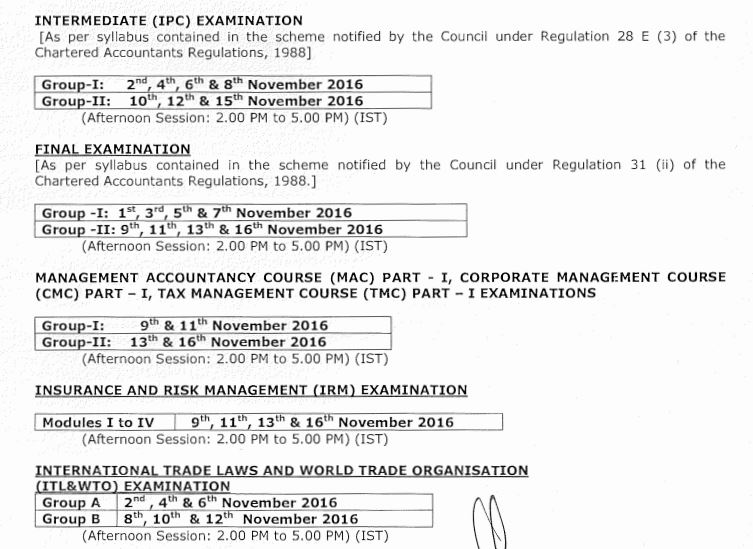
ICAI has announced the date sheet for CA IPC & CA Final for upcoming November 2016 Exams on 20th July 2016. CA IPC Exam will begin from 2nd  and will end on 15th  November 2016 and CA final Exam will begin on 1st  and ending on 16th November 2016.


The date sheet has been enclosed for your reference.

INTERMEDIATE (IPC) EXAMINATION
Group-I: 2nd, 4th, 6th & 8th November 2016
Group-II: 10th, 12th & 15th November 2016
(Afternoon Session: 2.00 PM to 5.00 PM) (IST)

FINAL EXAMINATION
Group -I: 1st, 3rd, 5th &  7th November 2016
Group -II: 9th, 11th, 13th  & 16th November 2016
(Afternoon Session: 2.00 PM to 5.00 PM) (IST)


Exam Fees:
INTEGRATED PROFESSIONAL COMPETENCE (IPC)
For Both the Groups: Rs. 1900/-
For one Group:         Rs. 1200/-


FINAL EXAMINATION
For Both the Groups Rs. 2700/-
For one of the Groups Rs. 1500/-


Cost of Purchasing form is Rs. 1000. However the fees of Rs. 1000 for purchasing the Exam form need not be paid in case the students opts for submitting the Exam form online. Applications for admission to these examinations are required to be made either online at http://icaiexam.icai.org 

The forms shall also be made available in the Regional and Branch Offices of the Institute and can be obtained there from on cash payment on or from 5th August, 2016.

Applications together with the prescribed fee by Demand Draft of any Scheduled Bank may be sent so as to reach the Additional Secretary (Examinations) at New Delhi not later than 26th August, 2016. However, applications will also be received at Delhi Office after 26th August, 2013 and upto 2nd September, 2013 with late fee of 600/-. Applications for the students’ examinations only duly filled in will also be received by hand delivery at the office of Institute at New Delhi and at the Decentralised Offices of the Institute at Mumbai, Chennai, Kolkata, Kanpur, Delhi, Ahmedabad, Bangalore, Chandigarh, Ernakulam, Hyderabad, Indore, Jaipur, Nagpur, Pune, Surat, Thane & Vadodara upto 2nd September, 2016. Candidates residing in these cities are advised to take advantage of this facility. Applications received after 2nd September, 2016 shall not be entertained under any circumstances.

To download the Official Announcement Click Here

ICAI CONVOCATION - 2016


In order to promote a sense of comradeship among members and for bringing them closer to the Institute, the Institute of Chartered Accountants of India (ICAI) organize Convocations for distributing certificates to the newly qualified members. In fact, this is an occasion to mark the entry of the new members into the fraternity.

ICAI invites members enrolled during the period October, 2015 to March, 2016 to participate in the Convocation for awarding the “Certificate of Membership” amidst the august gathering of distinguished dignitaries.

The schedule of the proposed Convocation is as follows:


The details about the venue and timing of the Convocation Programme Schedule will be intimated to the participants by the concerned Regional Offices of ICAI.

For any further information, members are requested to contact the concerned Regional Offices.


You may also like:


Tags: icai, CA, ICAI CONVOCATION - 2016 , CONVOCATION, 

ICAI asked Suggestions on GST

The biggest tax reforms in the history of Independent India are taking its final shape as the Constitution (122nd Amendment) Bill relating to the Goods and Service Tax (GST) has been passed by the Lok Sabha. Multiplicity of taxes, varying rates, costly compliance and lower revenue to the public exchequer are some of the important reasons which have compelled the administrators to bring in an effective tax system which can address such issues. GST will integrate the State economies and boost overall growth. It would subsume Central Excise Duty, Service Tax, Central Sales Tax, State Value Added Tax (VAT), Entry Tax, Octroi and other State levies, and pave the way for formation of a national market.

Being a proactive Institute, it has been always an endeavor of the ICAI to assist the country’s Government, Regulators and citizens by communicating various concerns and suggestions. The implementation of GST will immensely expand our professional horizons and bring tremendous opportunities to the profession. On our part, we have offered the CBEC, our unconditional support in paving the way for its implementation. Due to its neutral image and credibility, it is privilege of this Institute that government has always been open to the suggestions of the ICAI in any tax related matters and tries to act upon the same to the maximum possible extent.

You are invited to offer your suggestions, comments and thoughts on the said bill to the ICAI by mailing it to CA. Atul Gupta, Chairman, Indirect Taxes Committee, (Member of the Goods and Services Tax Network (GSTN) Advisory Committee as nominated by GSTN Board ) at idtc@icai.in. 

Student Registration Number of candidates who are admitted to the Common Proficiency Test(CPT) to be held on 14th June 2015

                                                                                                                                                                                             9th June 2015

It has been brought to our notice that the student registration number appearing on the admit cards relating to CPT June 2015 (hosted on www.icai.nic.in and in physical admit cards sent by post to those applicants who submitted the OMR exam forms) of some of the candidates is different from their registration number furnished by them in their exam forms. This error has crept in inadvertently, due to some technical problems.

The error has already been rectified in the data base of applicants for the CPT to be held on 14th June 2015. Individual communications have also been sent to all the affected candidates by way of a speed post letter as well as by emails, intimating their correct registration number. 

The affected candidates are advised to note that no fresh admit cards will be issued. Admit cards already issued are valid for admission to the Common Proficiency Test to be held on 14th June 2015. Affected candidates are advised to take note of the above and appear in the CPT as per the details contained in the admit cards already issued. The correct registration number will appear in their Result Cards. 

Affected candidates can click here to check their updated registration number in the data base of the applicants for CPT to be held on 14th June 2015. It may be noted that the list contains only those cases where the registration number on the admit card is different from the one furnished by the candidate in his exam form, which has since been rectified in our database. 

Cases where the registration number printed on the admit card is the same as provided by the candidate in his exam form, will not appear in the list, since there is no correction/updation required in such cases. 

In case of any discrepancy or for any clarifications, candidates can write to us at cpt_exam@icai.in or call the Help Desk at 0120 3054851, 852, 853, 854, 835, 0120-4953751, 752, 753 and 754. 

Further, it is clarified that there is no error in the student registration number on the admit card issued to rest of the candidates.


                                                                                                                                                                   Examination Department

Modification in the Syllabus of Intermediate (IPC) Paper 5: Advanced Accounting and applicability of the same for November, 2015 Examination and onwards

The topic of “Financial Reporting of Electricity Companies” would be excluded from the syllabus of Intermediate (IPC) Paper 5 : Advanced Accounting and the same would not be applicable from November, 2015 Examination and onwards.

Purchase from flipkart or Amazon via Studycafe special link and get Discounts on every product


Modification in the Syllabus of Final Paper 1: Financial Reporting and applicability of the same for the forthcoming CA Examinations

The topic of “Overview of International Accounting Standards (IAS) / International Financial Reporting Standards (IFRS), Interpretations by International Financial Reporting Interpretation Committee (IFRIC), Significant differences vis-a-vis Indian Accounting Standards; Understanding of US GAAPs, Applications of IFRS and US” would be excluded from the syllabus of Final Paper 1 : Financial Reporting and the same would not be applicable from November, 2015 Examination.

Further, the topic of “Introduction of Indian Accounting Standards (Ind AS); Comparative study of ASs vis-a-vis Ind ASs; Carve outs/ins in Ind ASs vis-à-vis International Financial Reporting Standards (IFRSs)” would be included in the syllabus of Final Paper 1 : Financial Reporting and the same would be applicable from May, 2016 Examination.


ICAI.


Purchase from flipkart or Amazon via Studycafe special link and get Discounts on every product


CA Final May 2015 question paper


Judgement dated 13th May, 2015 of the Hon’ble Supreme Court of India in a Disciplinary matter. - (14-05-2015)

Sub: Judgement dated 13th May, 2015 of the Hon’ble Supreme Court of India in a Disciplinary matter 

The Hon’ble Supreme Court of India in a landmark Judgment delivered on 13th May, 2015 in an appeal filed by a member of the Institute [Respondent in a disciplinary matter] and Others has upheld the Judgment given by the Division Bench of the Hon’ble High Court of Delhi at New Delhi whereby the Division Bench of Hon’ble High Court allowed the appeal of the Institute by holding, inter alia, that the procedure prescribed by the un-amended C.A. Act, 1949 would be applicable to pending proceedings in “Information” Cases and not the procedure prescribed after the amendment made by the Chartered Accountants (Amendment) Act, 2006. 

The Hon’ble Supreme Court was pleased to dismiss the appeal filed by the member and the Court agreed that the intention of the legislature in incorporating Section 21D (i.e. transitional provisions) was not to differentiate between disciplinary cases initiated on the basis of ‘complaint’ and ‘information’ and that for all cases pending before the Chartered Accountants Amendment Act, 2006, the old procedure, as laid down under Sections 21, 22 and 22A of the unamended Act, would continue to be followed. 

From the above judgement, it is clear that the Apex Court is in agreement with the procedure having been followed by the Disciplinary Committee whereby all such “information” cases which were pending prior to the amendment made in the Chartered Accountants Act, 1949 were considered and processed in accordance with the provisions of the un-amended Act and in terms of the transitional provisions of Section 21D of the amended Act.


Purchase from flipkart or Amazon via Studycafe special link and get Discounts on every product


Guidance Note on Accounting for Expenditure on Corporate Social Responsibility Activities (Issued May 15, 2015)

1 GN(A) 34   Guidance Note on Accounting for Expenditure on Corporate Social Responsibility Activities (Issued May 15, 2015)

(The Council of the Institute of Chartered Accountants of India (ICAI) has issued this Guidance Note on Accounting for Expenditure on Corporate Social Responsibility Activities which comes into effect from the date of its issuance. Pending finalisation of the Guidance Note, as it was under discussion with the relevant authorities, the Corporate Laws & Corporate Governance Committee had issued ‘Frequently Asked Questions on the provisions of Corporate Social Responsibility under Section 135 of the Companies Act 2013 and Rules thereon’ which, inter alia, provided an interim guidance with regard to certain accounting issues. On issuance of this Guidance Note on Accounting for Expenditure on Corporate Social Responsibility Activities, the FAQs related to areas covered by the Guidance Note stand withdrawn.)   

Introduction 

1. Section 135 of the Companies Act, 2013 (the Act), requires the Board of Directors of every company having a net worth of Rupees 500 crore or more, or turnover of Rupees 1,000 crore or more or a net profit of Rupees 5 crore or more, during any financial year, to ensure that the company spends in every financial year atleast 2% of the average net profits of the company made during the three immediately preceding financial years on Corporate Social Responsibility (CSR) in pursuance of its policy in this regard. The Act requires such companies to constitute a Corporate Social Responsibility Committee which shall formulate and recommend to the Board a Corporate Social Responsibility Policy which shall indicate the CSR activities to be undertaken by the company as specified in Schedule VII to the Act. 

Objective 

2. The objective of this Guidance Note is to provide guidance on recognition, measurement, presentation and disclosure of expenditure on activities relating to corporate social responsibility. 2 

Scope 

3. What constitutes CSR activities is specified in Schedule VII to the Act. Reference is also invited to the circular issued by the Ministry of Corporate Affairs (MCA) No. 21/2014 dated October 24, 2014. Accordingly, the Guidance Note does not deal with identification of activities that constitute CSR activities but only provides guidance on accounting for expenditure on CSR activities in line with the requirements of the generally accepted accounting principles including the applicable Accounting Standards. 

Definitions 

4. For the purpose of this Guidance Note, the definitions mentioned at sl. nos. (a) to (f) are reproduced from the Companies Act, 2013, and the Companies (Corporate Social Responsibility Policy) Rules, 2014 and in the event of any change in the Act or the Rules made thereunder, these definitions shall stand automatically revised/modified to that extent: 
(a) Any financial year: “any financial year” referred under sub-section (1) of Section 135 of the Act read with Rule 3(2) of Companies CSR Rule, 2014, implies ‘any of the three preceding financial years’. (Clarification vide MCA General Circular No. 21/2014) 

(b) Average Net Profit: Average Net Profit is the amount as calculated in accordance with the provisions of Section 198 of the Companies Act, 2013. 

(c) Financial Year: “financial year”, in relation to any company or body corporate, means the period ending on the 31st day of March every year, and where it has been incorporated on or after the 1st day of January of a year, the period ending on the 31st day of March of the following year, in respect whereof financial statement of the company or body corporate is made up: 

Provided that on an application made by a company or body corporate, which is a holding company or a subsidiary of a company incorporated outside India and is required to follow a different financial year for consolidation of its accounts outside India, the Tribunal may, if it is satisfied, allow any period as its financial year, whether or not that period is a year:

Provided further that a company or body corporate, existing on the commencement of this Act, shall, within a period of two years from such commencement, align its financial year as per the provisions of this clause; 

(d) Net Profit: “net profit” means the net profit of a company as per its financial statement prepared in accordance with the applicable provisions of the Act, but shall not include the following, namely:- 
(i) any profit arising from any overseas branch or branches of the company, whether operated as a separate company or otherwise; and 
(ii) any dividend received from other companies in India, which are covered under and complying with the provisions of section 135 of the Act: 

Provided that net profit in respect of a financial year for which the relevant financial statements were prepared in accordance with the provisions of the Companies Act, 1956, (1 of 1956) shall not be required to be recalculated in accordance with the provisions of the Act: 

Provided further that in case of a foreign company covered under these rules, net profit means the net profit of such company as per profit and loss account prepared in terms of clause (a) of sub-section (1) of section 381 read with section 198 of the Act. 

(e) Net worth: “net worth” means the aggregate value of the paid-up share capital and all reserves created out of the profits and securities premium account, after deducting the aggregate value of the accumulated losses, deferred expenditure and miscellaneous expenditure not written off, as per the audited balance sheet, but does not include reserves created out of revaluation of assets, write-back of depreciation and amalgamation; 

(f) Turnover: “turnover” means the aggregate value of the realisation of amount made from the sale, supply or distribution of goods or on account of services rendered, or both, by the company during a financial year; 

(g) Spend: The term ‘spend’ in accounting parlance generally means the liabilities incurred during the relevant accounting period. 

5. Rule 4 of the Companies (Corporate Social Responsibility Policy) Rules, 2014, requires that the CSR activities that shall be undertaken by the companies for the purpose of Section 135 of the Act shall exclude activities undertaken in pursuance of its ‘normal course of business’. The Rules also specify that CSR projects or programmes or activities that benefit only the employees of the company and their families shall not be considered as CSR activities in accordance with the requirements of the Act. Such programmes or projects or activities, that are carried out as a pre-condition for setting up a business, or as part of a contractual obligation undertaken by the company or in accordance with any other Act, or as a part of the requirement in this regard by the relevant authorities cannot be considered as a CSR activity within the meaning of the Act. Similarly, the requirements under relevant regulations or otherwise prescribed by the concerned regulators as a necessary part of running of the business, would be considered to be the activities undertaken in the ‘normal course of business’ of the company and, therefore, would not be considered CSR activities. 

Recognition and Measurement of CSR Expenditure in Financial Statements 

Whether Provision for Unspent Amount required to be created? 6. Section 135 (5) of the Companies Act, 2013, requires that the Board of every eligible company, “shall ensure that the company spends, in every financial year, at least 2% of the average net profits of the company made during the three immediately preceding financial years, in pursuance of its Corporate Social Responsibility Policy”. A proviso to this Section states that “if the company fails to spend such amount, the Board shall, in its report … specify the reasons for not spending the amount”. 

7. Further, Rule 8(1) of the Companies (Corporate Social Responsibility Policy) Rules, 2014, prescribes that the Board Report of a company under these Rules shall include an annual report on CSR, containing particulars specified in the Annexure to the said Rules, which provide a Format in this regard. 

8. The above provisions of the Act clearly lay down that the expenditure on CSR activities is to be disclosed only in the Board’s Report in accordance with the Rules made thereunder. In view of this, no provision for the amount which is not spent, i.e., any shortfall in the amount that was expected to be spent as per the provisions of the Act on CSR activities and the amount actually spent at the end 5 of a reporting period, may be made in the financial statements. The proviso to section 135 (5) of the Act, makes it clear that if the specified amount is not spent by the company during the year, the Directors’ Report should disclose the reasons for not spending the amount. However, if a company has already undertaken certain CSR activity for which a liability has been incurred by entering into a contractual obligation, then in accordance with the generally accepted principles of accounting, a provision for the amount representing the extent to which the CSR activity was completed during the year, needs to be recognised in the financial statements. 

9. Where a company spends more than that required under law, a question arises as to whether the excess amount ‘spent’ can be carried forward to be adjusted against amounts to be spent on CSR activities in future period. Since ‘2% of average net profits of immediately preceding three years’ is the minimum amount which is required to be spent under section 135 (5) of the Act, the excess amount can not be carried forward for set off against the CSR expenditure required to be spent in future. 

Other Considerations in Recognition and Measurement 

10. A company may decide to undertake its CSR activities approved by the CSR Committee with a view to discharge its CSR obligation as arising under section 135 of the Act in the following three ways: 

(a) making a contribution to the funds as specified in Schedule VII to the Act; or 

(b) through a registered trust or a registered society or a company established under section 8 of the Act (or section 25 of the Companies Act, 1956) by the company, either singly or along with its holding or subsidiary or associate company or along with any other company or holding or subsidiary or associate company of such other company, or otherwise ; or 

(c) in any other way in accordance with the Companies (Corporate Social Responsibility Policy) Rules, 2014, e.g. on its own. 

11. In case a contribution is made to a fund specified in Schedule VII to the Act, the same would be treated as an expense for the year and charged to the statement of profit and loss. In case the amount is spent in the manner as specified in paragraph10 (b) above the same will also be treated as expense for the year by charging off to the statement of profit and loss. The accounting for expenditure incurred by the company otherwise e.g. on its own would be accounted for in accordance with the principles of accounting as explained hereinafter. 

CSR activities carried out by the company covered under paragraph 10 (c) 

12. In cases, where an expenditure of revenue nature is incurred on any of the activities mentioned in Schedule VII to the Act by the company on its own, the same should be charged as an expense to the statement of profit and loss. In case the expenditure incurred by the company is of such nature which may give rise to an ‘asset’, a question may arise as to whether such an ‘asset’ should be recognised by the company in its balance sheet. In this context, it would be relevant to note the definition of the term ‘asset’ as per the Framework for Preparation and Presentation of Financial Statements issued by the Institute of Chartered Accountants of India. As per the Framework, an ‘asset’ is a “resource controlled by an enterprise as a result of past events from which future economic benefits are expected to flow to the enterprise”. Hence, in cases where the control of the ‘asset’ is transferred by the company, e.g., a school building is transferred to a Gram Panchayat for running and maintaining the school, it should not be recognised as ‘asset’ in its books and such expenditure would need to be charged to the statement of profit and loss as and when incurred. In other cases, where the company retains the control of the ‘asset’ then it would need to be examined whether any future economic benefits accrue to the company. Invariably future economic benefits from a ‘CSR asset’ would not flow to the company as any surplus from CSR cannot be included by the company in business profits in view of Rule 6(2) of the Companies (Corporate Social Responsibility Policy) Rules, 2014. 

13. In some cases, a company may supply goods manufactured by it or render services as CSR activities. In such cases, the expenditure incurred should be recognised when the control on the goods manufactured by it is transferred or the allowable services are rendered by the employees. The goods manufactured by the company should be valued in accordance with the principles prescribed in Accounting Standard (AS) 2, Valuation of Inventories. The services rendered should be measured at cost.. Indirect taxes (like excise duty, service tax, VAT or other applicable taxes) on the goods and services so contributed will also form part of the CSR expenditure. 

14. Where a company receives a grant from others for carrying out CSR activities, the CSR expenditure should be measured net of the grant. 

Recognition of Income Earned from CSR Projects/Programmes or During the Course of Conduct of CSR Activities 

15. Rule 6 (2) of the Companies (Corporate Social Responsibility Policy) Rules, 2014, requires that “the surplus arising out of the CSR projects or programs or activities shall not form part of the business profit of a company”. The term ‘surplus’ ordinarily means excess of income over expenditure pertaining to an entity or an activity. Thus, in respect of a CSR project or programme or activity, it needs to be determined whether any surplus is arising therefrom. A question would arise as to whether such surplus should be recognised in the statement of profit and loss of the company. It may be noted that paragraph 5 of Accounting Standard (AS) 5, Net Profit or Loss for the Period, Prior Period Items and Changes in Accounting Policies, inter alia, requires that all items of income which are recognised in a period should be included in the determination of net profit or loss for the period unless an Accounting Standard requires or permits otherwise. As to whether the surplus from CSR activities can be considered as ‘income’, the Framework for Preparation and Presentation of Financial Statements issued by the Institute of Chartered Accountants of India, defines ‘income’ as “increase in economic benefits during the accounting period in the form of inflows or enhancements of assets or decreases of liabilities that result in increases in equity, other than those relating to contributions from equity participants”. Since the surplus arising from CSR activities is not arising from a transaction with the owners, it would be considered as ‘income’ for accounting purposes. In view of the aforesaid requirement any surplus arising out of CSR project or programme or activities shall be recognised in the statement of profit and loss and since this surplus can not be a part of business profits of the company, the same should immediately be recognised as liability for CSR expenditure in the balance sheet and recognised as a charge to the statement of profit and loss. Accordingly, such surplus would not form part of the minimum 2% of the average net profits of the company made during the three immediately preceding financial years in pursuance of its Corporate Social Responsibility Policy. Presentation and Disclosure in Financial Statements. 

16. Item 5 (A)(k) of the General Instructions for Preparation of Statement of Profit and Loss under Schedule III to the Companies Act, 2013, requires that in case of companies covered under Section 135, the amount of expenditure incurred on ‘Corporate Social Responsibility Activities’ shall be disclosed by way of a note to the statement of profit and loss. From the perspective of better financial reporting and in line with the requirements of Schedule III in this regard, it is recommended that all expenditure on CSR activities, that qualify to be recognised as expense in accordance with paragraphs 10-14 above should be recognised as a separate line item as ‘CSR expenditure’ in the statement of profit and loss. Further, the relevant note should disclose the break-up of various heads of expenses included in the line item ‘CSR expenditure’. 

17. The notes to accounts relating to CSR expenditure should also contain the following: 

(a) Gross amount required to be spent by the company during the year.

(b) Amount spent during the year on: 

     In cash                       Yet to be paid in cash                               Total 

(i) Construction/acquisition of any asset 

(ii) On purposes other than (i) above 

The above disclosure, to the extent relevant, may also be made in the notes to the cash flow statement, where applicable. 

(c) Details of related party transactions, e.g., contribution to a trust controlled by the company in relation to CSR expenditure as per Accounting Standard (AS) 18, Related Party Disclosures. 9 

(d) Where a provision is made in accordance with paragraph 8 above the same should be presented as per the requirements of Schedule III to the Companies Act, 2013. Further, movements in the provision during the year should be shown separately. 

To download the Guidance note in PDF  Click Here

Purchase from flipkart or Amazon via Studycafe special link and get Discounts on every product


Non-applicability of Wealth-tax for November, 2015 Paper 7 CA Final Examination

Important Announcement 

Sub: Non-applicability of Wealth-tax for November, 2015 CA Final Examination.

The Finance Bill, 2015, introduced in the Parliament on 28th February, 2015, has proposed to abolish the levy of wealth-tax under the Wealth-tax Act, 1957 with effect from assessment year 2016-17. The Finance Bill, 2015 would be enacted in May 2015, after it is passed by both the Houses of the Parliament and receives the assent of the President of India. The amendments made by the Finance Act, 2015 would be applicable from May, 2016 examination. The relevant assessment year for May, 2016 and November, 2016 examinations is A.Y.2016-17. Hence, consequent to the abolition of levy of wealth-tax by the Finance Act, 2015 with effect from A.Y.2016-17, wealth-tax would not be applicable from May, 2016 examination. 

The Council, at its 342nd meeting held from 15th to 17th April, 2015, decided that the Wealth-tax Act, 1957 and Rules thereunder would not be applicable for November, 2015 examination also, even though the relevant assessment year for November 2015 examination is A.Y.2015-16. Accordingly, Wealth-tax Act, 1957 and Rules thereunder would NOT be applicable for November, 2015 examination of Paper 7: Direct Tax Laws.

Purchase from flipkart via Studycafe special link and get Discounts on every product


Announcement on CARO, 2003 and Additional Reporting under the Companies Act, 2013

ANNOUNCEMENT ON CARO, 2003 AND ADDITIONAL REPORTING UNDER THE COMPANIES ACT, 2013

We are receiving queries from the members regarding applicability of CARO, 2003 along with Auditors’ Report on financial statements of companies for the financial year 2014-15. The Ministry of Corporate Affairs (MCA) is working on it and has constituted a Committee for this purpose to analyse the contents of the Order to be made under section 143(11) of the Companies Act, 2013 for the Financial Year 2014-15. ICAI is also a member of the said committee. We are given to understand by MCA that an Order being a smaller version of CARO 2003, applicable for the financial year 2014-15, may be notified soon under section 143(11) of the Companies Act, 2013. However, at this juncture, to bring more clarity, this Announcement is released in consultation with the Ministry.

The Companies Act, 1956 has ceased to have effect from 01st April, 2014. As a corollary, the Companies (Auditor’s Report) Order, 2003 issued under section 227(4A) of the said Act also ceases to have effect from the said date.

Section 143(11) of the Companies Act, 2013 which came into force from 01st April, 2014 provides that “the Central Government may, in consultation with the National Financial Reporting Authority, by general or special order, direct, in respect of such class or description of companies, as may be specified in the order, that the auditor’s report shall also include a statement on such matters as may be specified therein.”

Accordingly, it may be noted that as when an Order is notified by the Central Government under section 143(11) of the Companies Act, 2013, the members would be required to report thereon as a part of their statutory audit reports.

Until the aforesaid Order is issued, no additional reporting under section 143(11) of the Companies Act, 2013 is required by the Auditors for the financial year 2014-15.

Members are advised to keep a watch on the MCA site (www.mca.gov.in) as well as the ICAI site (www.icai.org) for further announcements in this regard.
CA ABHIJIT BANDYOPADHYAY
Chairman, Auditing & Assurance Standards Board


Admit Cards for May 2015 Exams issued by ICAI. - (09-04-2015)

Admit cards in respect of all eligible candidates admitted to the Intermediate (IPC) and Final May 2015 examination, with their photographs and signatures on them, are hosted on www.icai.nic.in.

Candidates may print their admit cards from the said website.

For downloading/printing of the admit cards, candidates will have to enter the following details on the site:
  • Student registration number or bar code number printed on the examination form
  • Personal Identification Number (PIN)
PIN is the four digit number of the candidate’s choice entered by him/her the relevant column in the examination form.

In terms of the decision of the Examination Committee of the Institute, physical admit cards are being sent by post, only to those who submitted physical examination forms ( i.e. OMR ). The practice of sending physical admit cards by post, to those who had submitted their exam forms online, is discontinued with effect from May 2014 examination onwards.

Physical admit cards sent by post as well as those printed from the website are valid for admission to the examination.

Candidates may also visit the FAQs on subject hosted in the FAQs section of www.icai.org for more details.

For any further clarifications, write to/contact:

Final candidates: : final_examhelpline@icai.in
Intermediate(IPC) candidates : intermediate_examhelpline@icai.in

Help Line Telephone numbers: 0120 3054 851, 852, 853 or 835

Fax 0120 3054 841, 843


-->